Showing posts with label music. Show all posts
Showing posts with label music. Show all posts
Thursday, February 24, 2011
Khyaal
Khyal (or Khayal, Hindi: ख़्याल, Urdu: خیال) is the modern genre of classical singing in North India. Its name comes from an Arabic word meaning "imagination". It is thought to have developed out of the qawwal singing style. It appeared more recently than dhrupad, is a more free and flexible form, and it provides greater scope for improvisation. Like all Indian classical music, khyal is modal, with a single melodic line and no harmonic parts. The modes are called raga, and each raga is a complicated framework of melodic rules.

Wednesday, February 23, 2011
Gazal
The gazal (Arabic/Pashto/ Persian/Urdu: غزل; غزل; Hindi: ग़ज़ल; Turkish: gazel) is a poetic form consisting of rhyming couplets and a refrain, with each line sharing the same meter. A ghazal may be understood as a poetic expression of both the pain of loss or separation and the beauty of love in spite of that pain. The form is ancient, originating in 6th century Arabic verse. It is derived from the Arabian panegyric qasida. The structural requirements of the ghazal are similar in stringency to those of the Petrarchan sonnet. In its style and content it is a genre which has proved capable of an extraordinary variety of expression around its central themes of love and separation. It is one of the principal poetic forms which the Indo-Perso-Arabic civilization offered to the eastern Islamic world.
Tanpura

Tabla
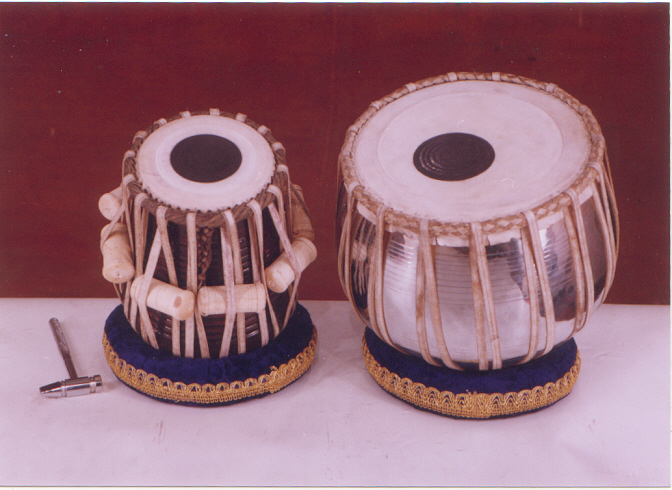
The tabla (or tabl, tabla) (Hindi: तबला) is a popular Indianpercussion instrument (of the membranophone family) used in Hindustani classical music and in popular and devotional music of the Indian subcontinent. The instrument consists of a pair of hand drums of contrasting sizes and timbres. The term 'tabla is derived from an Arabic word, tabl, which simply means "drum."
Playing technique involves extensive use of the fingers and palms in various configurations to create a wide variety of different sounds, reflected in the mnemonic syllables (bol). The heel of the hand is used to apply pressure or in a sliding motion on the larger drum so that the pitch is changed during the sound's decay.
Sarangi
 The Sārangī (Hindi: सारंगी, Punjabi: ਸਰੰਗੀ, sarangī) is a bowed, short-necked string instrument of India. It plays an important role in India's Hindustani classical music tradition. Of all Indian instruments, it is said to most resemble the sound of the human voice – able to imitate vocal ornaments such as gamakas(shakes) and meend (sliding movements). It is also said to be the hardest Indian instrument to master.
Subscribe to:
Posts (Atom)