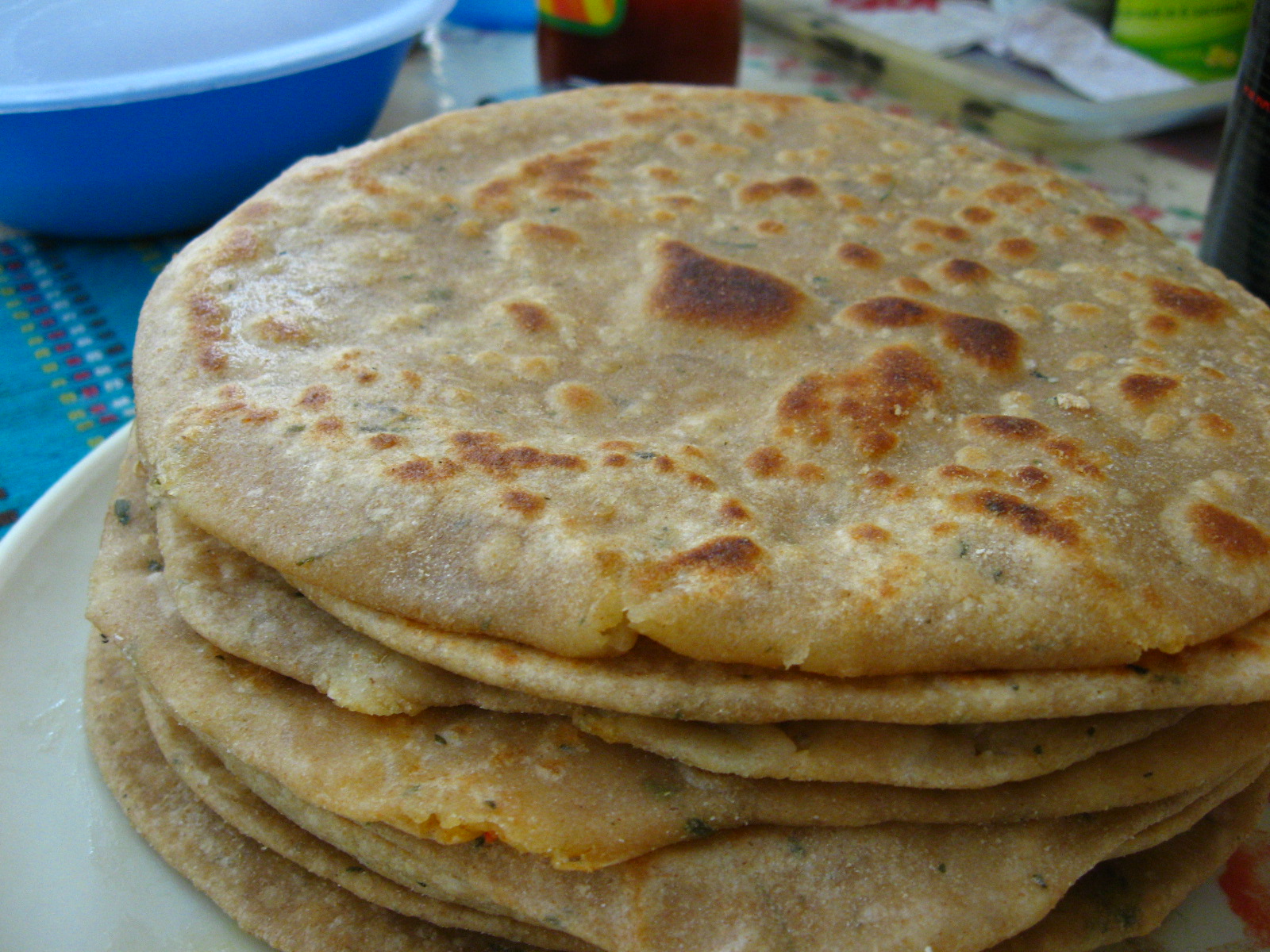
A paratha/parantha (Hindi: पराठा, Urdu: پراٹھا) is an Indian flat-bread that originated in the Indian subcontinent.
It is one of the most popular unleavened flat-breads in Indian cuisine, Pakistani cuisine and Bengali cuisine and is made by pan frying whole-wheat flour on a tava. The paratha dough usually contains ghee or cooking oil which is also layered on the freshly prepared paratha. Parathas are usually stuffed with vegetables such as boiled potatoes, leaf vegetables, radishes or cauliflower and/orpaneer (South Asian cheese).
Aloo (pronounced Aalu) paratha is stuffed with spicy boiled potato and onions mix.
Thandai is a cold drink prepared with a mixture of almonds, fennel seeds, magaztari seeds (watermelon kernel), rose petals, pepper, khus khus(white poppy) seeds, cardamom, saffron, milk and sugar. Could be easily found in KPK mostly in Peshawar. It is native to India and is often associated with the Holi festival.
Jalebi (sometimes Jalibi) (jilebi, Hindi: जलेबी) is an Arabian sweet popular in countries of the Indian Subcontinent such as India, Pakistan, Nepal, and Bangladesh. It is made by deep-frying batter in pretzel or circular shapes, which are then soaked in syrup.
Paan, from the word pān (Hindi: पान, Urdu: پان) is an Indian/Pakistani and South East Asian tradition of chewing betel leaf (Piper betle) with areca nut and slaked lime paste. There are many regional and local variations. It is a Piper betle leave chew, chewed as a palate cleanser, a breath freshener, and for digestive purposes as well. It is offered to guests and visitors as a sign of hospitality (after meals at both personal and social occasions) and at the beginning of social events. It has a symbolic value at ceremonies and cultural events in India and southeast Asia. Paan makers may use mukhwas ortobacco in paan fillings. Most paan contains areca nuts as a filling. Other types include what is called sweet paan, where sugar, candied fruit and multi-colored, sweetened, candy-like fennel seeds are used.